
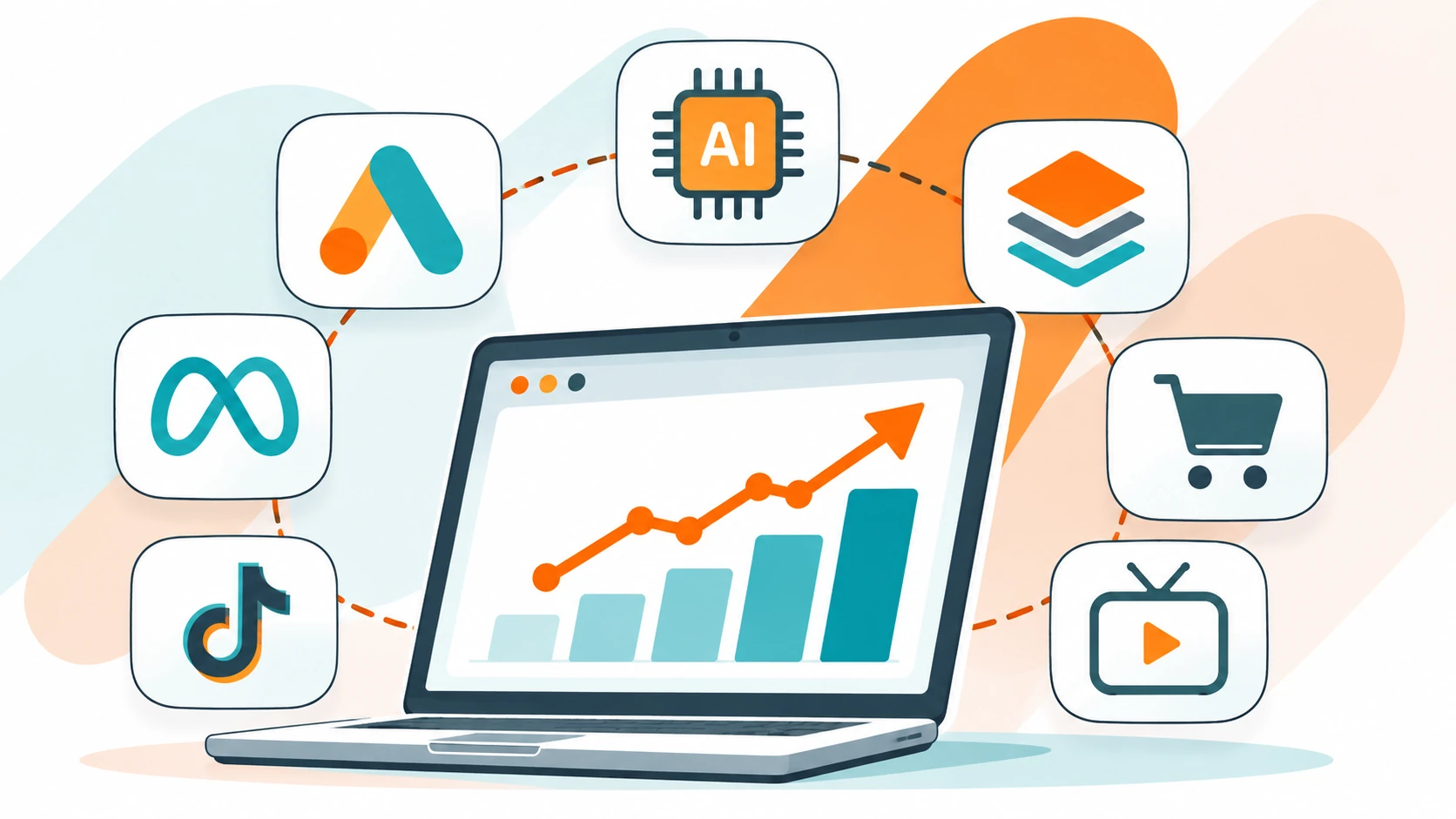
From automated Google Ads campaigns to programmatic advertising, social media, and Connected TV: discover the technologies reshaping digital advertising and how to choose the right solutions for your business.
Advertising is undergoing a major transformation. Innovative advertising technologies now allow businesses to reach potential customers through increasingly automated platforms, first-party data, artificial intelligence, and digital channels that were once difficult to combine into a single marketing strategy.
Innovation is no longer just about creating more attractive advertisements. It is changing how audiences are identified, advertising budgets are allocated, messages are personalized, and results are measured.
A small business can use Google Ads to reach people actively searching for a service. An e-commerce company can promote products through automated campaigns, while a brand can connect with its audience through social media videos or advertising on connected televisions.
However, access to more sophisticated technology does not automatically lead to better results.
The real challenge is choosing advertising solutions that support business objectives without investing in complex tools that lack a clear strategy.
What Are Innovative Advertising Technologies?
The term innovative advertising technologies refers to digital platforms, systems, and methods that use data, automation, and advanced technologies to improve advertising planning, delivery, and measurement.
Compared with traditional advertising models, these systems often provide greater flexibility in campaign management and more detailed insights into user interactions.
Their main characteristics include automated bidding, artificial intelligence, personalized advertising content, cross-channel integration, and conversion measurement.
Not all these technologies are entirely new. Programmatic advertising, for example, has existed for many years.
What is changing is the growing integration of automation, data, creative production, and decision-making systems.

Why Digital Advertising Continues to Grow
The European advertising market confirms the increasing importance of digital investment.
According to IAB Europe’s AdEx Benchmark 2025, published in July 2026, European digital advertising expenditure reached €131 billion in 2025, representing 10.5% growth compared with the previous year.
Video advertising, social media, and Retail Media were among the particularly dynamic segments.
This development reflects changing consumer behavior. People increasingly use search engines, social platforms, video services, and marketplaces at different stages of their purchasing journey.
For businesses, this creates more opportunities to connect with potential customers, but it also makes the advertising landscape more complex.
1. Google Ads and Advertising Automation
Google Ads is one of the best-known examples of how advertising technology continues to evolve.
Search campaigns allow businesses to reach users who express specific needs through relevant keywords and search queries.
Alongside traditional search advertising, automated systems increasingly use machine learning to support bidding, creative combinations, and ad delivery.
Performance Max Campaigns
Performance Max campaigns allow advertisers to reach audiences across several Google advertising channels, including Search, YouTube, Display, Discover, Gmail, and Maps, depending on campaign eligibility and available placements.
Advertisers define objectives, budgets, creative assets, and other useful signals. Google’s automation then works to identify conversion opportunities.
This approach can be particularly relevant for e-commerce businesses and companies with reliable conversion data.
However, relying on automation without monitoring data quality can result in inefficient spending.
Smart Bidding
Smart Bidding strategies use algorithms to adjust advertising bids according to campaign objectives.
Available approaches include maximizing conversions, targeting a desired cost per acquisition, and optimizing return on advertising spend.
During 2026, Google continued introducing tools designed to provide advertisers with greater flexibility and control, including additional options for channel prioritization and budget allocation.
The underlying principle remains unchanged: automation should be guided by clear commercial objectives and reliable performance measurement.
2. Programmatic Advertising: Buying Ad Space Through Technology
Programmatic advertising uses technology to automate parts of the process of buying and selling digital advertising inventory.
In some models, individual ad impressions are traded through automated auctions that take place in fractions of a second.
This enables advertisers to manage campaigns across websites, applications, and other digital environments.
Programmatic advertising may use contextual information, aggregated data, and audience segments, subject to applicable regulations and platform requirements.
Benefits and Challenges
Programmatic advertising can offer greater campaign flexibility, access to different advertising inventories, and opportunities for ongoing optimization.
However, it also presents important challenges.
Inventory quality, supply-chain transparency, invalid traffic, and brand safety require careful attention.
For this reason, evaluating programmatic campaigns solely on impressions or cost per thousand impressions is rarely sufficient.
Businesses should also consider the quality of placements and their contribution to broader marketing objectives.
3. Generative AI and Advertising Creativity
Artificial intelligence is transforming how advertising materials are produced.
Generative AI tools can assist with writing advertising copy, creating images, developing graphic variations, producing storyboards, and generating video content.
For example, a company may develop several versions of an advertising message for different audience segments while maintaining a consistent brand identity.
AI can also support data analysis and help identify potential campaign improvements.
Can AI Replace Human Creativity?
Automation can accelerate many tasks, but it does not eliminate the need for professional expertise.
An effective advertisement must communicate a genuine benefit, remain consistent with the brand, and meet audience expectations.
Human oversight is also important for checking factual accuracy, intellectual property rights, and compliance with advertising requirements.
One risk is producing large quantities of technically acceptable advertisements that lack originality or a distinctive brand message.
The most valuable innovation is therefore not simply generating more content, but using technology to improve the quality and relevance of advertising communication.
4. Social Advertising: Increasingly Automated Campaigns
Social media platforms provide advertising systems that help businesses promote products, services, and content to potentially interested audiences.
Meta Ads, TikTok Ads, and LinkedIn Ads serve different marketing needs.
Facebook and Instagram can support brand awareness, lead generation, and online sales.
LinkedIn can be particularly useful for certain B2B strategies because of its professional audience targeting capabilities.
TikTok may offer opportunities for businesses that can communicate effectively through video content suited to the platform.
From Manual Targeting to Automation
Social advertising platforms increasingly rely on algorithms to identify opportunities for ad delivery.
In many cases, advertisers can use broader audience definitions while allowing automated systems to make some distribution decisions.
This makes creative quality even more important.
A video that clearly demonstrates how a product works may be more persuasive than a generic advertisement, even when both use advanced delivery technology.
For small and medium-sized businesses, platform selection should depend on the target audience and purchasing journey rather than the popularity of a particular social network.
5. Retail Media: Advertising Close to the Point of Purchase
Retail Media includes advertising opportunities provided by retailers, marketplaces, and commercial platforms.
Brands can promote products within environments where consumers are already searching for or purchasing items.
Examples include sponsored product placements in marketplace search results and advertisements displayed within retailer platforms.
One of the main advantages is the ability to reach consumers relatively close to a purchasing decision.
Retail Media can also make use of first-party data collected by retailers, subject to applicable privacy requirements.
Which Businesses Can Benefit?
Retail Media is particularly relevant for manufacturers, distributors, consumer brands, and e-commerce companies operating through marketplaces or established retail networks.
It may not be a priority for a small professional practice or a business selling highly specialized services.
As with other advertising systems, its suitability depends on the relationship between the channel, target audience, and commercial objectives.
6. Connected TV: Advertising on Internet-Connected Televisions
Connected TV (CTV) refers to television environments connected to the internet where digital advertising can be delivered.
Advertising opportunities vary depending on the streaming services, platforms, and inventory available.
Compared with traditional linear television advertising, some CTV systems provide planning and measurement capabilities that are more closely aligned with digital advertising.
This makes it possible to integrate television video campaigns with other digital marketing activities.
Is Connected TV Suitable for Small Businesses?
That depends on the market, geographic area, advertising objectives, and minimum budget requirements.
For some local or regional companies, Connected TV may provide an interesting brand awareness opportunity.
For businesses with limited budgets focused on generating immediate inquiries, Search advertising may be more appropriate.
Connected TV should therefore be evaluated as one component of a broader strategy rather than a universal solution.
7. Digital Out of Home: Outdoor Advertising Goes Digital
Digital Out of Home (DOOH) represents the digital evolution of outdoor advertising.
It includes advertising screens installed in public spaces, shopping centers, railway stations, airports, and other locations.
Unlike traditional printed billboards, digital content can be updated remotely and, in certain environments, scheduled according to time, location, or specific conditions.
Programmatic solutions can also automate some aspects of advertising inventory purchasing.
For example, a business might use a DOOH campaign to promote the opening of a new store or increase brand awareness within a particular geographic area.
However, potential exposure should not be confused with directly measurable commercial results.
8. Contextual Advertising and First-Party Data
Changes in privacy regulations and tracking technologies have renewed interest in contextual advertising.
Contextual advertising involves displaying advertisements based on the content of the page or digital environment where they appear.
For example, a company selling sports equipment might advertise its products alongside content about fitness and training.
This approach does not necessarily require tracking individual behavior across multiple websites.
At the same time, first-party data is becoming increasingly important.
First-party data consists of information collected directly by businesses through their own interactions with customers and users.
When processed lawfully and responsibly, this information can support more relevant communication and improved measurement.
Advertising innovation must therefore develop alongside appropriate personal data protection practices.
Which Advertising Technologies Should an SME Choose?
There is no single advertising platform that is best for every business.
The right choice depends on market demand, target audience, available budget, and commercial objectives.
A company providing emergency repairs or technical services might benefit from Google Ads campaigns targeting searches with strong commercial intent.
An e-commerce business could combine Shopping campaigns, Performance Max, social advertising, and remarketing where appropriate.
A B2B company with a long sales cycle might prioritize specialized search queries, educational content, and campaigns targeting professional audiences.
For brands seeking greater awareness, video advertising, social media, and other reach-oriented formats may be relevant.
The most effective approach is not necessarily the one that uses the largest number of platforms.
It is the one that connects advertising activities with measurable business goals.
How Much Should Businesses Invest in Innovative Advertising?
Advertising investment should be determined by considering customer value, profit margins, conversion rates, and sustainable customer acquisition costs.
Consider a purely illustrative example.
Suppose a company receives 100 advertising clicks at an average cost of €2 per click.
Its total advertising expenditure would be €200.
If 5% of those clicks generated a quotation request, the business would receive five leads at an average cost of €40 per lead.
However, this information alone would not establish whether the campaign was profitable.
The company would also need to know how many leads became paying customers, what profit margins those customers generated, and what additional costs were involved.
For this reason, advertising budgets should be connected to financial performance rather than traffic metrics alone.
How to Measure Innovative Advertising Performance
Advanced advertising systems provide numerous performance indicators, but not all are equally important.
Click-Through Rate (CTR) measures the percentage of impressions that generate clicks.
Cost Per Click (CPC) represents the average cost of each click.
Conversion Rate indicates the proportion of interactions or sessions that produce a desired action, depending on the measurement system.
Cost Per Acquisition (CPA) measures the average cost of an acquisition or defined conversion.
Return on Advertising Spend (ROAS) compares advertising-attributed revenue with advertising expenditure.
Return on Investment (ROI) requires a broader assessment of costs and financial returns.
These indicators can be complemented by lead quality, actual sales, and customer lifetime value.
Tools such as Google Analytics 4, Google Tag Manager, and Customer Relationship Management (CRM) systems can support data collection and analysis when properly configured.
However, attribution models and tracking limitations may prevent businesses from reconstructing every stage of the customer journey.
Common Mistakes When Adopting New Advertising Technologies
One of the most frequent mistakes is adopting a new platform simply because it is considered innovative.
Technology cannot automatically compensate for an uncompetitive offer, a poorly designed website, or unclear communication.
Another mistake is allowing algorithms to manage campaigns without checking conversion quality and actual business outcomes.
Using too many advertising channels simultaneously can also become problematic, particularly when the budget is too limited to generate meaningful data.
Finally, businesses should not overlook landing page quality.
An advertising campaign may reach the right audience but still lose valuable opportunities if the destination page is slow, confusing, or difficult to use.
The Future of Advertising: Automation, AI, and New Channels
The future of digital advertising will likely involve greater integration between automated systems, data, and creative content.
Artificial intelligence will continue influencing campaign planning, advertising production, and performance analysis.
At the same time, channels such as Retail Media, Connected TV, and Digital Out of Home will offer additional opportunities for reaching audiences.
However, these innovations will not be equally relevant to every business.
The most important skill will be understanding which tools to use, how to integrate them, and when to adjust the strategy.
The goal should not be to adopt the newest technology, but to build a sustainable, measurable advertising system aligned with business growth.
How Dopstart Helps Businesses Choose Advertising Solutions
For small and medium-sized businesses, navigating Google Ads, Meta Ads, automation, artificial intelligence, and emerging advertising platforms can be challenging.
Dopstart approaches digital marketing by first examining business objectives and identifying the most relevant channels.
Advertising activities can be integrated with SEO, web design, landing page optimization, and data analysis to create a consistent journey from traffic acquisition to conversion.
The priority is not to launch as many campaigns as possible, but to identify investments that can make a meaningful contribution to business growth.
Conclusion
Innovative advertising technologies are changing how businesses communicate and acquire customers.
Artificial intelligence, programmatic advertising, automation, and emerging digital channels offer valuable opportunities, but they also require expertise, planning, and careful performance evaluation.
For small and medium-sized businesses, competitive advantage does not necessarily come from using the most sophisticated technology.
It comes from choosing appropriate tools, communicating effectively, and measuring what genuinely matters.
Would you like to invest in digital advertising but are unsure which platforms and technologies are right for your business?
Contact Dopstart to discuss a personalized advertising strategy and explore opportunities suited to your company’s needs.
Frequently Asked Questions About Innovative Advertising Technologies
They are digital systems and methods that use automation, data, and artificial intelligence to plan, deliver, optimize, and measure advertising campaigns.
Major examples include Google Ads, Meta Ads, programmatic advertising, Retail Media, Connected TV, Digital Out of Home, and AI-powered advertising solutions.
AI can support bidding strategies, audience selection, creative production, campaign optimization, and performance analysis.
Yes, but the right solutions depend on business objectives and budget. Small businesses can benefit from a limited number of carefully selected platforms.
Programmatic advertising uses automated technologies to manage the buying and selling of digital advertising inventory. Traditional advertising may rely more heavily on manual planning and negotiation.
Performance Max campaigns use Google’s automation technology to distribute advertisements across multiple Google channels while pursuing advertiser-defined conversion objectives.
Retail Media refers to advertising opportunities provided by retailers and marketplaces, often allowing brands to reach consumers close to the point of purchase.
Costs vary according to the platform, market competition, professional services required, and advertising budget. There is no universal minimum investment.
By evaluating conversions, lead quality, customer acquisition costs, attributed revenue, and the overall financial sustainability of the investment.
The decision depends on available expertise, campaign complexity, and internal resources. An agency can provide support with strategy, technical implementation, optimization, and performance analysis.

