

Have you invested in your website, but you are receiving very few requests for quotes? Are people visiting your site, and perhaps some of your pages even rank well on search engines, yet the phone is not ringing? Have you also tried advertising campaigns and still find yourself wondering why your website is not bringing in customers?
This situation is more common than you might think. In most cases, the problem is not simply a lack of traffic. You need to understand where the journey that should turn a visitor into a potential customer is breaking down.
The first step is to move beyond a widespread assumption: having a website and receiving visitors does not necessarily mean acquiring customers. An effective website needs to be found by the right people, respond to their needs, build trust and guide them towards a specific action.
Why Your Website Is Not Bringing in Customers Even If It Gets Traffic
When a website is not bringing in customers, the first reaction is often to look for more traffic. But more visitors do not necessarily mean more business opportunities.
Let’s look at a practical example. One company receives 5,000 visits per month and generates five requests for quotes. A competitor receives only 1,000 visits but generates twenty leads. Despite receiving less traffic, the second website is performing much better from a business perspective.
This happens because we need to consider who is visiting the website, what they are looking for and what they find within the first few seconds after arriving. A thousand curious visitors may be worth less than one hundred people who are genuinely interested in your service.
Your Website Does Not Generate Leads If It Attracts the Wrong People
SEO can significantly increase visibility, but not every search has the same value.
Someone searching for “what does SEO mean?” is probably looking for information. Someone searching for “SEO consultant for ecommerce”, on the other hand, may be much closer to choosing a professional. Both visitors may arrive through a search engine, but their intentions are very different.
Informational content remains important for building authority, but an effective strategy must also reach people who are showing potential commercial intent.
Therefore, if your website is not generating leads, before changing its graphics, layout or colours, you should analyse where your visitors are coming from and, above all, what they are actually searching for.
Visitors Need to Understand Your Website Within Seconds
Open your homepage and look at it as if you knew nothing about the company. Within a few seconds, can you understand what it offers, who it is for and why it might be useful to you?
Many websites fail to produce results because they speak from the company’s point of view rather than the customer’s. Expressions such as “quality”, “professionalism”, “experience” and “innovative solutions” may all be true, but hundreds of competitors are probably saying exactly the same things.
Customers want answers to much more practical questions: can you solve my problem? Can I trust you? Why should I choose you rather than someone else?
Every page should provide clear answers. If visitors have to make an effort to understand what you are offering, they will probably look elsewhere.
A Beautiful Website Does Not Necessarily Mean an Effective Website
One of the most common mistakes is confusing aesthetics with commercial effectiveness. A website can be modern and visually appealing while still generating very few leads.
The real question is: what objective was it designed to achieve?
During the website design process, there was probably plenty of discussion about colours, images and animations. But if there was little discussion about the target audience, customer needs, objections and conversions, you may have created an attractive shop window without a proper commercial journey behind it.
An effective website should not turn every page into an aggressive sales pitch. Instead, it should naturally guide visitors from information to further exploration and, when they are ready, towards making contact.
Why Should Customers Choose You?
Understanding what you sell is not enough. Potential customers also want to know why they should choose your company.
Online, they can compare several competitors within minutes. Simply saying that your company is reliable or professional has little value if you cannot demonstrate it.
Reviews, testimonials, results and case studies can help reduce uncertainty. A good case study explains the initial problem, what was done to address it and the results achieved.
Trust is not created by saying that you are good at what you do. It is created by giving potential customers concrete reasons to believe it.
If Your Website Is Not Bringing in Customers, Check Your Offer
Sometimes the problem is neither SEO nor the website design. The problem is the offer itself.
You can have a fast, well-ranking website, but if customers do not understand the value of your service, generating conversions will still be difficult.
For example, “80-page SEO audit” describes a feature of a service. “We identify what is preventing your website from gaining greater visibility and generating new leads” explains the potential benefit.
Customers rarely buy a technical activity simply for the sake of it. They buy the improvement they hope that activity will help them achieve.
Your Call to Action Should Explain What to Do Next
When visitors become interested, they should immediately understand what their next step is.
This is where the call to action becomes important.
“Submit”, “Click here” or even “Contact us” can be too generic. “Book your first free consultation” or “Request a project assessment” explains much more clearly what will happen next.
The call to action should be visible and consistent with the content of the page without turning the website into an aggressive sequence of buttons.
The contact form should also be simple. If you ask for too much information at the first stage, you risk losing people who are genuinely interested. It is also essential to check that the form works correctly on smartphones and that enquiries receive a prompt response.
Website Not Bringing in Customers: What Should You Do?
If you are wondering what to do when your website is not bringing in customers, do not immediately start by building a new website or increasing your advertising budget.
First, you need to identify and understand the problem.
If very few people are visiting, you may have a visibility problem. If visitors arrive but are not interested in your services, you need to improve the quality of your traffic. If potential customers arrive but do not contact your company, you should analyse your content, offer, trust signals and calls to action. If enquiries arrive but do not turn into customers, the problem could involve pricing, quotes, response times or your sales process.
Investing more money without identifying the bottleneck risks simply making the problem bigger.
SEO and Conversions Need to Work Together
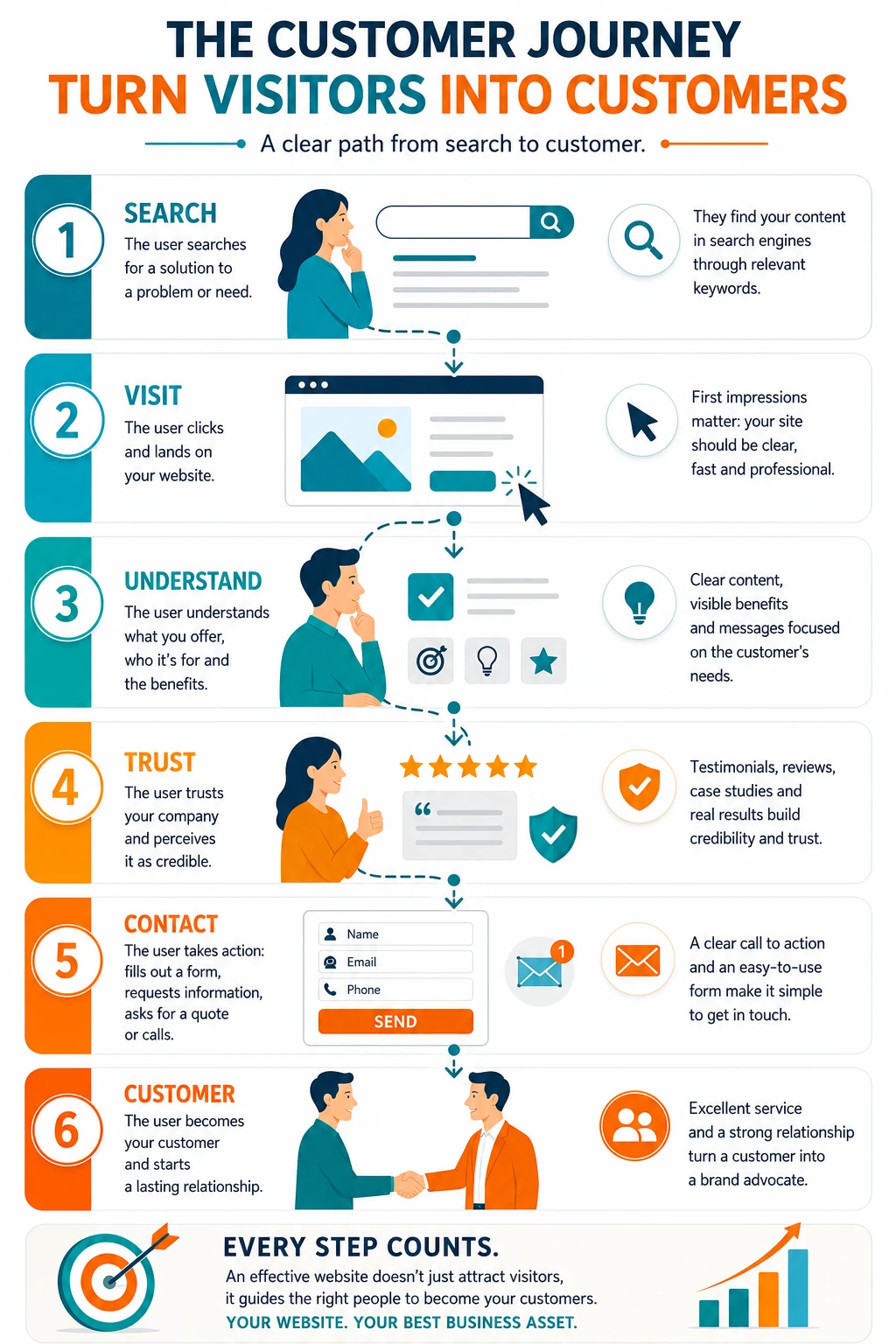
SEO should not be limited to increasing website traffic. An effective strategy creates a journey:
search → visit → understanding → trust → contact → customer.
If that journey breaks down, you need to identify where it happens. You may need better content, stronger trust signals, case studies, a clearer offer or a different call to action.
The same applies to advertising campaigns. Paying to send more people to a page that does not convert simply means paying to increase the number of visitors who eventually leave.
This is why traffic needs to be interpreted rather than simply counted. Pages that bring in customers can be far more valuable than pages that attract thousands of visitors without generating any enquiries.
We Can Help You Understand Why Your Website Is Not Bringing in Customers
If your website is not bringing in customers, the first step does not necessarily have to be rebuilding it. You first need to understand what is not working.
At Dopstart, we can analyse your website, SEO performance and conversion journey. We look at traffic quality, landing pages, content, value proposition, calls to action and lead generation.
We do not promise that every visitor will become a customer: that would be unrealistic. What we can do is work to remove the obstacles that may currently be preventing genuinely interested people from contacting your business.
If you want to discover why your website is not bringing in customers, you can book an initial free strategic consultation.
We will analyse your current situation to understand where improvements can be made and which digital marketing activities genuinely make sense for your project.
Want to know whether digital marketing consulting can really work for your business?
If you are looking for a clear direction, measurable KPIs and a digital marketing strategy focused on tangible results, we can start with an initial strategic assessment.
Initial screening
Request an initial digital marketing analysis
This helps us understand your current situation, goals, priorities, growth potential and whether we are the right fit for your project. If we don’t see a realistic potential ROI, we’ll tell you upfront.
Outcome: fit / no fit + #1 priority + recommended next steps
Response within 1–2 business days · Selected projects only

